Atheroplasty™
A New Era In Endovascular Revascularization
Simultaneous Lateral Intraplaque Cutting, Compression, and Channel Formation – in a Single Step
INTRAPLAQUE ATHEROPLASTY
A Paradigm Shift for Endovascular Crossing and Vessel Preparation
Restoring Blood Flow—The True Goal of Revascularization
Revascularization isn’t just a treatment – it’s the body’s natural way to heal. By restoring blood flow, we strive to address symptoms like claudication and prevent serious complications like amputation. AngioSafe is redefining revascularization with a safe, predictable, and effective approach.1
Three Mechanisms.All Morphologies.One Pass.
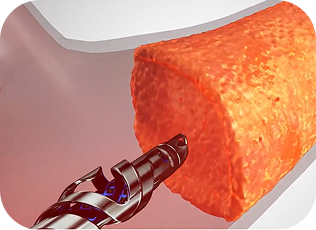
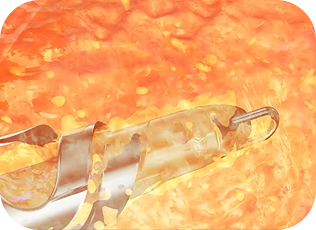
How Atheroplasty Works
- Lateral Intraplaque Cutting – stainless steel tip and cutting loop puncture, displace, and compress even moderately to severely calcified plaques.
- Plaque Compression – large profile centering system provides self-guided intraluminal positional control within the blood vessel. As the centering system traverses the CTO, the wings further dissect and compress the plaque locally in the lateral direction, without harming the vessel wall.
- Channel Formation – the immediate result from use of Santreva-ATK in femoropopliteal CTOs is lumen gain and blood flow restoration through a channel, thereby revascularizing the previously ischemic distal zone.1
Tackle the Plaque,Preserve the Wall
AngioSafe’s Atheroplasty can tackle any stenotic lesion, including CTOs, irrespective of level of calcification or lesion length.1
Atheroplasty™ technology does not require any capital equipment and is the first wire-free crossing platform that combines plaque modification and channel formation in a single device, simplifying one of the most complex procedures in cardiovascular medicine.
1 RESTOR-1 Pivotal Clinical Study, data on file (ClinicalTrials.gov ID: NCT04663867)
In a subset of RESTOR-1 subjects, post-hoc quantitative secondary analysis of imaging data suggests that Santreva-ATK may form a 2.8mm channel in a 5mm vessel, representing >55% mean lumen gain in fempop arteries. Data on file.